
1. Document Authenticity Verification Requirements
2. Revision History
| Date | Document version | Description |
|---|---|---|
| 2025-09-03 | 2.0 | Initial Draft. |
| 2025-09-03 | 1.2 | Added support for Type 5, NFC chip-based documents. |
| 2025-09-03 | 1.1 | Fixed minor edits with the first version of DocAuth certification requirements. |
3. Introduction
The FIDO Alliance’s mission is to "reduce the world’s reliance on passwords." To accomplish this, the FIDO Alliance promotes the development of, use of, and compliance with standards for authentication, identity verification, and device attestation. This mission has begun to succeed with the platform and browser adoption of passkey solutions, but are incomplete without strong options for account creation and account recovery. Many internet services, including financial and government services, require validation of a user’s identity before they are allowed to create an account and attach a FIDO authenticator (e.g., a passkey). Similarly, when a user attempts to create an account, reset a password, or recover account access, their identity should be validated again. Weak account creation and account recovery can undermine FIDO’s value proposition for strong security.
In general, the user experience includes presenting a government-issued identity document via a camera, and then a "selfie" photo or a live video. The validation system checks the format of the document, the document image and the selfie to score the validity and consistency of the information provided. There are a variety of potential attacks against document authentication including fake documents, stolen documents and a variety of environmental variables including bad lighting and poor cameras that can make the validation difficult. These potential attacks and environmental factors must be balanced against the user experience to provide a "safe" and "simple" solution that is consistent with the FIDO brand.
This document contains the FIDO Document Authenticity Requirements and Test Procedures for the Document Authenticity Verification Certification Program.
3.1. Audience
The intended audience of this document is the Certification Working Group (CWG), IDWG, FIDO Administration, the FIDO Board of Directors, Document Authentication Vendors and FIDO Accredited Laboratories.
The owner of this document is the Identity Verification and Binding Working Group (IDWG).
3.2. FIDO Roles
- Certification Working Group
-
FIDO working group responsible for the approval of policy documents and ongoing maintenance of policy documents once a certification program is launched.
- Identity Verification and Binding Working Group
-
FIDO working group responsible for the creation and maintenance of these requirements.
- Vendor
-
Party seeking certification. These vendors provide identity verification services and are responsible for providing the testing harness to perform both online and offline testing that includes enrollment systems (with data capture sensor) and verification software.
- FIDO Accredited Laboratory
-
Party performing testing. Testing will be performed by third-party test laboratories Accredited by FIDO to perform Document Authenticity Certification Testing and/or Document Authenticity Certification.
- FIDO Accredited Document Authenticity Verification Laboratory
-
Laboratory that has been accredited by the FIDO Alliance to perform FIDO Document Authenticity Verification Testing for the Document Authenticity Verification Certification Program.
- FIDO Member
-
A company or organization that has joined the FIDO Alliance through the membership process.
3.2.1. Document Authenticity Data and Evaluation Terms
- Genuine Document
-
the original version of an identity document in its physical form that has not fabricated or been tampered with
Note: Also synonymous with Authentic Document
- Identity Document
-
A document issued by a State authority to an individual for providing evidence of the identity of that individual [reference: https://ec.europa.eu/home-affairs/pages/glossary/identity-document_en ]
- Image
-
This certification document uses the term _image_ throughout to refer to the identity document captured by the system. The term _image_ can refer to either a photo or video sample of the presented identity document.
- Document Type
-
An individual document grouping requested by the vendor to be tested
- Inauthentic Document:
-
A fabricated identity document or a tampered version of an existing document. These can be digital or physical documents.
Note: Photocopies and scanned/photo captured images of genuine documents are not considered as inauthentic documents or document tampering. See Document Liveness.
- Document Fraud Attack:
-
The use of an inauthentic document within a document verification transaction.
- Document Attack instrument (DAI)
-
Object or image used in a document fraud attack (e.g. forgery or counterfeit).
- DAI species
-
Class of document attack instruments created using a common production method.
- Document Tampering
-
Digital or physical modifications made to a genuine identity document which renders that document materially different from the evidence of identity that the document was originally issued for
- Counterfeit Documents
-
Any document attempting to reproduce a genuine document made outside of the issuing authority of the document.
- Document Liveness
-
A live document is the is presence of the original physical document.
Note: See § 3.3.2.12 Document Liveness.
- Document False Accept Rate (DFAR)
-
The proportion of document verification transactions performed with a DAI that are incorrectly confirmed as genuine.
- Document False Reject Rate (DFRR)
-
The proportion of genuine document verification transactions with truthful claims of an genuine document that are incorrectly denied.
- Document Failure-To-Acquire
-
A document was not captured/detected; no payload sufficient for verification was produced.
- Document Failure-To-Extract
-
A document extract (capture) was successful, but data could not be extracted or processed to complete verification.
- Document Failure-to-Acquire Rate (DFTA)
-
Proportion of document verification attempts for which the system fails to capture or locate an image or signal.
- Document Failure-to-Extract Rate (DFTE)
-
Proportion of document verification attempts for which the system fails to extract the required information or features either at all, or with sufficient quality for further processing.
- Document True Reject Rate (DTRR)
-
The proportion of transactions performed with a DAI that were correctly identified by the system.
- Target of Evaluation (TOE)
-
The product or system that is the subject of the evaluation. See the [TOE](https://fidoalliance.org/specs/biometric/requirements/#TOE) Description section in this document.
- TOE Description
-
A description of the TOE provided by the vendor to the laboratory in advance of the certification.
- Test Subject
-
User whose biometric data is intended to be enrolled or compared as part of the evaluation. See Section 4.3.2 in [ISOIEC-19795-1].
- Test Crew
-
Set of test subjects gathered for an evaluation. See Section 4.3.3 in [ISOIEC-19795-1].
- Target Population
-
Set of users of the application for which performance is being evaluated. See Section 4.3.4 in [ISOIEC-19795-1].
- Test Operator
-
Individual with function in the actual system. See Section 4.3.6 in [ISOIEC-19795-1].
- Approved Evaluator
-
FIDO Accredited Laboratory personnel acting as the Test Operator.
- Document Verification Transaction
-
Sequence of attempts on the part of a user for the purposes of document verification. See section 4.2.3 in [ISOIEC-19795-1].
- Document Verification
-
Process by which the user submits an identity document and an accept or reject decision regarding the authenticity of the document.
- Blur
-
An image of an ID document or photo that is not clearly visible or are not sufficiently sharp.
- Glare
-
A photo of a document where there is a reflection of a light source that hides useful information from the image.
3.2.2. Key Words
The key words "MUST", "MUST NOT", "REQUIRED", "SHALL", "SHALL NOT", "SHOULD", "SHOULD NOT", "RECOMMENDED", "MAY", and "OPTIONAL" in this document are to be interpreted as described in [RFC 2119](https://fidoalliance.org/specs/biometric/requirements/#biblio-rfc2119).
-
SHALL indicates an absolute requirement, as does MUST.
-
SHALL NOT indicates an absolute prohibition, as does MUST NOT.
-
SHOULD indicates a recommendation.
-
MAY indicates an option.
3.3. Scope
Complete automated, online document authenticity verification requires multiple steps, some of which are in scope of this document and some of which will be covered by other documents.:
In scope:
-
Automatically verifying identity document authenticity
This document focuses on automatically verifying identity document authenticity for existing vendor solutions and provides certification criteria for vendors and test procedures that FIDO-Accredited Laboratories can use for evaluating document authentication capabilities.
Note: The current version of the certification program handles only automated checks. It is difficult to ensure the integrity of the current test design when a manual check is included; a specific test design would need to be devised to appropriately assess the performance involving manual checks. The vendor may include a manual component as part of the commercial product. This test is intended to measure the performance only of the automated version. Future versions of the certification program may expand to manual checks.
Out of Scope. To be included in future requirements documents:
-
Verifying that identity document pictures match a selfie picture or video of the subject
-
Verifying the liveness of the subject in the selfie
Separate documents (to be defined) will define certification criteria for liveness checks and the biometric match of “selfie” photos against the photo on the presented document.
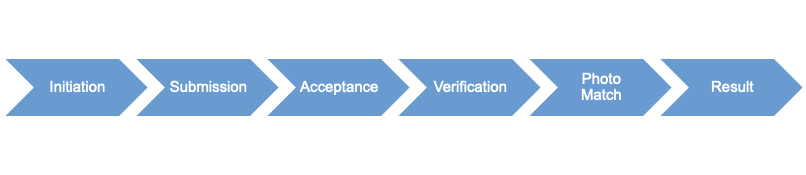
The following sub-sections include background information on Document Sophistication tiers and the Classification of Threats, and outlines for both what is in scope, and out of scope for this requirements document.
3.3.1. Document Sophistication
Security documents have different levels of sophistication. Depending on the document’s inherent security characteristics, each document is classified into a tier. However, the existence of a security feature does not imply that the documentation authentication method checks these security features, as all may not be visible by a user’s device using visible light.
These document authenticity requirements focus on Tier 3, 4 & 5 documents. Tier 1 & 2 documents are out of scope, but have been included as examples. The FIDO Secretariat SHOULD maintain a list of government documents and their respective tiers. Tier 1 & 2 documents are out of scope because these documents do not contain sufficient security features to facilitate scalable and effective fraud detection using only software and through a mobile device.
Tier 5 - Tier 5 documents SHALL meet the requirements for Tier 4. Documents of this tier are documents with state-of-the-art cryptographic security features. Documents in this tier SHALL:
-
embedded chip technology (e.g., contact card, RFID, NFC)
-
protect the digital information (including biometric information) used for identification using cryptographic security features that prevent the information being forged.
-
the cryptographic security features must be able to prove which organisation issued the document using an automated system.
Some documents may contain a machine readable zone (MRZ), barcode or QR code from which the access key to the embedded chip must be derived. The MRZ or barcode isn’t itself a security feature but a necessity in order to access the protected information in the chip.
Tier 5 is in scope.
Tier 4 - Documents of this tier are highly-secured documents with state-of-the-art security features to prevent forging or counterfeiting. Tier 4 documents SHALL meet requirements for Tier 3. Documents in this tier SHALL also include at least three or more of the following security features:
-
optically variable ink (OVI), holograms, watergrams
-
primary photo interacts with the substrate / background print
-
personalization font with unique character sets and/or diacritical marks
-
guilloché (e.g., intricate and subtle patterns of thin interwoven lines)
-
tactile laser engraving
-
micro printing
-
ghost image
The security features must protect all of the information that is being used for identification.
Note: The existence of a security feature does not imply that the documentation authentication method checks these security features. For example, some features are not visible by a user’s device using visible light.
Tier 4 is in scope.
Tier 3 - Tier 3 documents SHALL meet requirements for Tier 2. Tier 3 documents SHALL contain some security features designed to prevent forging or counterfeiting. Documents in this tier SHALL:
-
have a consistent template format
-
include the person’s name
-
include a photo of the person
-
use specific fonts within a version
Documents in this tier SHALL Include one or more of the following security features:
-
optically variable ink (OVI), holograms, watergrams
-
primary photo interacts with the substrate / background print
-
personalization font with unique character sets and/or diacritical marks
-
guilloché (e.g., intricate and subtle patterns of thin interwoven lines)
-
tactile laser engraving
-
micro printing
-
ghost image
Tier 3 documents MAY also include:
-
machine readable zone (MRZ), barcode or QR code
Tier 3 is in scope.
Tier 2 - A Tier 2 document must meet requirements for Tier 1 and include information that’s unique to either the identity (e.g. a photo) or the document (e.g. a document reference number). Tier 2 documents MAY contain features such as:
-
barcodes
-
QR codes
-
checksums
-
other logical checks that enable automated data cross-comparison that can be tested using machine reading
-
specific fonts
-
consistent templates
Tier 2 documents do not contain security features that prevent physical forging or counterfeiting.
Tier 2 is out of scope.
Tier 1 - A document with no physical security features where only basic fraud checks can be performed by comparing the data with authoritative sources and confidence in its authenticity based on a digital image is nil. To be used for identification the document must contain at least 2 of the following:
-
the person’s name
-
the person’s date of birth
-
the person’s place of birth
-
the person’s address
-
the person’s photo or other biometric information
-
a reference number
Tier 1 is out of scope.
3.3.2. Classification of Threats
This section contains background information explaining the classification of threats, including fraud type, and what types of threats are in scope and out of scope for this requirements document.
3.3.2.1. Counterfeit
Counterfeit documents are any attempt (digital or physical) to reproduce a genuine document made outside the issuing authority of the document. When using the term counterfeit document, it is referring to the entire document.
Examples of counterfeit techniques include:
-
Complete digital fabrications using templates available online
-
Fantasy and camouflage documents (e.g. country does not exist)
-
Specimen documents
-
Complete physical reproductions printed on any substrate (plastic/paper/etc.)
Counterfeit detection testing is in scope. Photocopies and scanned/photo captured images of counterfeit documents are considered as inauthentic documents and are in scope.
3.3.2.2. Forgery/Tampering
Forged documents are changes made to a genuine document such as:
-
Changing/tampering with any variable information digitally or physically
-
Insertion or replacement of the applicant picture
-
Removing information
Photocopies and scanned/photo captured images of tampered documents are considered as inauthentic documents or document tampering and are in scope.
Note: Photocopies and scanned/photo captured images of genuine documents, used without edit, are not considered as inauthentic documents or document tampering. Such non-live images can make it easier to obscure tampering and may be easier to confuse with forgeries or counterfeit documents. This may be considered in future versions of the requirements.
Resistance to the video or image replay of genuine documents stolen through malware or other means is currently out of scope. This will be considered in future parts of the certification program which consider the security integrity of the system.
Scanned/photo captured images of genuine documents are considered genuine documents as part of the Digital Document Images Test. A photo capture of a photocopied genuine document shall not be included in the genuine document test.
3.3.2.3. Digital Tampering
Digital tampering refers to manipulation of a captured image of a genuine document.
For example, digital tampering may include changing the following:
-
Text (e.g., incorrect font, misaligned text)
-
Images
-
Portrait
-
The presence of "boxes" around characters / fields coupled with interruptions of background printing.
-
Sudden changes in the color of the portrait.
3.3.2.3.1. Physical Tampering
Physical tampering refers to physical alteration of an authentic identity document.
For the purposes of testing, the FIDO Accredited Laboratory can obtain images of documents that have undergone physical tampering, as part of the Digital Document Test.
Direct testing as part of the Physical Document Test for identity documents that have undergone physical tampering are currently out of scope, pending clarification of legal constraints around the ability to obtain inauthentic documents.
Forgery detection which includes Digital and Physical tampering are within the scope of this requirements document.
3.3.2.4. Expired or Invalidated Document
Inauthentic document test may include genuine documents that are expired or invalidated. For example, the issuing authority or user may invalidate the document (e.g. by punching a hole in a Driver’s License).
3.3.2.5. Similarity Fraud
Similarity fraud is threats relating to mismatching the user in front of the camera to the ID document. Similarity fraud is within the scope of this program but will be covered in a separate requirements document.
3.3.2.6. Technical/Security Attack
Technical/security attacks (e.g. on encryption or backend systems) are an attack on the integrity or security of the system.
Technical/security attacks are out of scope of this requirements document.
3.3.2.7. Procedural
Procedural attacks are on the identification procedure as well (e.g. timing attacks, swapping cards during the process). Examples include attacks which are run against systems that take several pictures of a document. They involve swapping the identity document (real or fake) between capturing document images of the front and back side, or when capturing data vs. security features.
Procedural attack detection testing is out of scope of this requirements document.
3.3.2.8. Presentation (Liveness) Attack
Presentation to the biometric data capture subsystem with the goal of interfering with the operation of the biometric system [ISOIEC-30107-3].
3.3.2.9. Injection Attack
Attacks which insert (false) data bypassing the biometric capture module.
Note: Injection attacks are within the scope of this program but are covered in a separate Face Verification Requirements Document, currently under development.
3.3.2.10. Deepfake
Deepfakes refer to videos, images, audio or text created with artificial intelligence (AI) technologies such as Generative Adversarial Networks (GANs) or Recurrent Neural Networks (RNNs). These content synthesis technologies enable media representations of non-existent subjects as well as subjects doing or saying things they’ve never done or said. [DeepTrust Alliance, 2020].
Note: In the context of these requirements, deepfakes are a method to create fraud. Deepfakes can be detected by presentation attack detection if presented to the capture devices. Alternatively, deepfake may be used as part of an injection attack, bypassing the capture device. Injection attacks are addressed through securing the communication between the biometric capture and further processing.
3.3.2.11. Face Morph
A face morph is the face image which is created as a combination of two individuals, either of which can match the face morph. This is an attack typically done on the reference image by way of identity document tampering.
3.3.2.12. Document Liveness
A live document is presence of the original physical original document. This version of the certification program does not consider Document Liveness.
Photocopies and scanned/photo captured images of genuine documents are not tested as inauthentic documents or document tampering since the test methods of this program relies on a database of digital images to represent inauthentic documents. Such non-live images can make it easier to obscure tampering and may be easier to confuse with forgeries or counterfeit documents. Document liveness may be considered in future versions of the requirements as part of the Physical Document Test. Inauthentic documents are further described in Section § 7.2.1.1 Test Set Preparation for Document Fraud Attacks.
Photocopies and scanned images of genuine documents are not tested as inauthentic documents or document tampering since the test methods of this program relies on a database of digital images to represent inauthentic documents. Such non-live images can make it easier to obscure tampering and may be easier to confuse with forgeries or counterfeit documents. Inauthentic documents are further described in Section § 7.2.1.1 Test Set Preparation for Document Fraud Attacks.
Resistance to the video or image replay of genuine documents stolen through malware or other means is currently out of scope. This will be considered in future parts of the certification program which consider the security integrity of the system.
Note: Scanned/photo captured images of genuine documents are considered genuine documents as part of the Digital Document Images Test. A photo capture of a photocopied genuine document SHALL not be included in the genuine test sample for the digital document image test. A photo capture of a photocopied tampered document can be included in the test sample for the digital document image test as part of the inauthentic document images.
3.3.2.13. Misuse
A misuse refers to the simple misuse of the system. This misuse is not necessarily malicious or intentional.
Misuse detection is out of scope of this requirement document.
3.3.3. Document Types
A vendor shall specify the set of document types to be assessed. Document type is defined by the combination of the Country of origin, document classification and revision. Document classification is the originating purpose of the document and may include national identity card, driving license, passport, residence permit, visa, voter identification card or any other issued identification document. Vendor requests for document type certifications shall follow the above pattern to specify the set of document types covered. Vendors may additionally request more specificity in the document types to be covered, defining each as the combination of country of origin, domestic region of origin (such as state or province), and document classification. The set of document types requested by the vendor may be of any supported document sophistication tier. Tier 5 documents are in scope when the region or requested set under test requires them for a representation of the public document mix for that area.
Note: For example a vendor may request specificity for "US Driver’s Licenses" which doesn’t contain Tier 5 document types, whereas "US Documents" or "North American Documents" would contain Tier 5 documents that need to be represented in the test set.
4. Criteria
This chapter contains the requirements that are mandatory to be met by a product in order to obtain certification.
Note: The following paragraphs assume specific requirements for the DFRR and the DFAR. Also, specific requirements for test sizes are derived from these values. The values have been briefly discussed within the FIDO IDWG and IDWG DocAuth How Sub Group, but it should be clearly mentioned that these values should only be seen as examples. Due to the need to derive test size requirements from the values for the error rates, it has not been easily possible to work with placeholders (like "X"). The final values for the requirements for DFRR and DFAR will need further discussion within the complete IDWG.
4.1. Performance Levels
4.1.1. Document False Reject Rate (DFRR)
The Document False Reject Rate (DFRR) section focuses on the error rate for genuine (legitimate) documents.
Document False Reject Rate SHALL meet the requirement of less than 10% for the upper bound of a 95% confidence interval. DFRR is measured at the transaction level, defined below.
The actual achieved DFRR SHALL be documented by the laboratory. Requirements on reporting for Digital Image Test can be found in section § 7.2.2 Digital Reporting Requirements, Requirements on reporting for Physical Document Test can be found in section § 8.2.4 Physical Reporting Requirements.
The threshold, or operational point, SHALL be fixed during testing for ALL document verification tests, as described in this requirements document. It shall be set in accordance with the descriptions in the § 5 TOE Description.
For Digital Document Images Test, the capture device is bypassed and the images of genuine and fraudulent documents are tested directly by the processing and decision components of the remote identity verification solution. Document Failure-to-Aquire Rate (DFTA) in this program is only relevant for the Physical Document Test. Document-Failure-to-Extract Rate (DFTE) applies to both Digital and Physical Document Tests.
For Physical Document Test testing described in section § 8 Physical Document Tests, the number of attempts allowed per document verification transaction SHALL be fixed during testing. It is set by the vendor and documented in the TOE Description. The number of attempts SHALL be no more than 5. For the purposes of testing with human subjects, the total time of the transaction SHOULD be no longer than 200 seconds and the document processing time, once request is sent to the document verification processing engine, SHOULD be less than 60 seconds.
DFRR SHALL be estimated by the following equation:
DFRR for the Digital Image Test (%) = (Number of Genuine Transactions for which the decision is either reject OR DFTE for all attempts)*100 / (Total Number of Genuine Document Verification Transactions Conducted)
DFRR for the Physical Document Test (%) = (Number of Genuine Transactions for which the decision is reject OR DFTA for all attempts OR DFTE for all attempts)*100 / (Total Number of Genuine Document Verification Transactions Conducted)
All errors encountered during the testing SHALL be recorded.
4.1.2. Document False Accept Rate (DFAR)
The Document False Accept Rate section focuses on the error rate for inauthentic documents.
Each of the selected Level A, B, and C Document Attack Instrument (DAI) species SHALL achieve a DFAR of less than 10%. Levels A, B, and C are defined in section § 7.2.1.1 Test Set Preparation for Document Fraud Attacks. This section describes levels of sophistication of the document fraud attacks.
Document False Accept Rate SHALL meet the requirement of less than 10%. DFAR is measured at the transaction level.
The actual achieved DFAR SHALL be documented by the FIDO Accredited Laboratory. Requirements on reporting for Digital Image Tests can be found in section § 7.2.2 Digital Reporting Requirements. The threshold, or operational point, SHALL be fixed during testing for ALL Document Verification Tests, as described in this requirements document. It shall be set in accordance with the descriptions in the TOE Description.
The number of attempts allowed per document verification transaction SHALL be fixed during testing. It is set by the vendor and documented in the TOE Description.
4.1.2.1. Limitation
The calculation of DFAR SHALL be based on the following equation:
DFAR (%) = (Number of Inauthentic Document Verification Transactions for which the Decision is Accept) * 100 / (Total Number of Inauthentic Document Verification Transactions Conducted)
4.2. Statistical Analysis
The following description contains a stepwise description of the test:
-
An independent laboratory shall derive a test set S from their test database D that complies with the following requirements:
-
S shall only contain Images that are compliant to the requirements of the § 5 TOE Description.
-
S shall be representative of the document types that the TOE claims to recognize; this specification means that S shall at least contain ten images of genuine documents and ten images of fraudulent documents for each document type that the TOE claims to recognize in its § 5 TOE Description.
-
The TOE SHALL NOT have any chance to recognize the type of document or the type of test by the filename or metadata of an image. The test laboratory SHALL make sure filenames and any metadata contained in the images submitted are suitably obfuscated to prevent the TOE using them to determine the type of document or the type of test being conducted.
-
The independent laboratory shall shuffle all images of S and submit them to the TOE one after the other. The answer of the TOE (genuine, fraud) shall be recorded along with any additional information.
-
After the test has been completed, the FIDO Accredited Laboratory SHALL rate all answers of the TOE and compile a list with a comprehensive test overview containing the following columns:
| Timestamp | image | expected result | result | comment |
| ... | …. | ... | …. | .. |
From the test list, the independent laboratory shall calculate:
-
Observed DFAR
-
The variance of the DFAR as follows n*p*q where q=(1-p), n is the number of attempts with images of inauthentic documents and p=observed DFAR
-
The upper value PU of the confidence interval (at 95% confidence) as follows
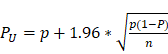
-
-
Observed DFRR
-
The variance of the DFRR as follows n*p*q where q=(1-p), n is the number of attempts with images of inauthentic documents and p=observed DFRR
-
The upper value PU of the confidence interval (at 95% confidence) as follows
-
The test has been passed if the upper bound of the confidence interval for the DFAR is below 10% and the upper bound of the confidence interval for the DFRR is below 10%.
Note: Recommend using 95% confidence value which results in a c value of approx. 1.96.
Note: Test sizes are designed in a way that for both test sets (genuine and inauthentic) may show one error and would still pass. If working with minimum numbers of the test sizes, the TOE would fail with two or more errors per test set.
5. TOE Description
In the beginning of the certification process, the vendor shall provide a TOE Description to the laboratory and to FIDO. This TOE Description is intended to cover all relevant aspects of the TOE with respect to the certification. It serves the vendor, the Accredited Laboratory and FIDO to develop and document a common understanding of the system that shall be certified. After the certification is finished, this document is also helpful for relying parties as it contains a comprehensive description of all relevant information for the certification.
The TOE Description shall, at a minimum, cover the following topics:
-
A description of the system seeking certification and its boundaries (the TOE).
-
A description of the specific Tier 3, Tier 4, and Tier 5 documents that the TOE supports.
-
A description of the requirements that the TOE has for images to process (e.g. minimum resolution); vendors can set different requirements to evaluate different document sophistication levels.
-
A description of the transaction policy of the TOE (i.e. how many attempts are allowed per transaction).
-
A description of any parameters that can be used to adjust the performance or security of the TOE and their chosen settings.
-
A list of supported consumer device types, platforms and versions supported. The test is limited to consumer devices (mobile phones, tablets, personal computer). Dedicated document scanners are out of scope. Specific devices under test will be managed by the Test Laboratory with guidance from the FIDO Secretariat.
Additional TOE description for Tier 5 documents:
-
For vendors that support Tier 5 documents, vendors SHALL indicate which forms of evaluation they seek: (1) the NFC chip read and/or (2) an optical image of the Tier 5 document.
-
For evaluations of both NFC and optical for Tier 5 documents, evaluation of Tier 5 documents SHALL be performed separately for (1) the NFC chip read and (2) an optical image of the Tier 5 document. Results SHALL be reported separately as Tier 5 (NFC) and Tier 5 (optical) and SHALL be indicated separately on the certificate.
-
A description of how fallback occurs when NFC cannot be read for Tier 5 documents SHALL be provided.
Note: When falling back to an optical check the TOE SHALL conform to the evaluation parameters of a Tier 4 document optical check, including the required physical security features and the DFAR and DFRR requirements.
6. Common Test Harness
For each system to be evaluated, the vendor SHALL provide to the FIDO Accredited Laboratory a solution which automatically verifies identity document authenticity without manual verification by a human, and, has at minimum:
-
For Digital Document Images Test: Functionality to perform the Digital Images tests for document-only evaluation, according to specifications defined in section § 7 Digital Document Images Test.
-
Version of documentation authentication solution that supports:
-
Either cloud or localized version which meets the following:
-
The TOE SHALL be provided to the laboratory as a software container. This container can be hosted by the laboratory or a cloud service provider at the discretion of the laboratory. The lab must not dictate with cloud service provider must be used.
-
The vendor and FIDO certified laboratory shall enter into an agreement specifying the terms and conditions:
- Vendor SHALL create a specific environment for testing, separate from the commercial or development environment.
- The TOE SHALL be in complete control of the FIDO Accredited Laboratory
- Laboratory SHALL have exclusive access to the TOE during the test.
- Testing images and any other personal data SHALL not be stored for later use by vendor or shared with the vendor in any other way. Note: For example, this can be accomplished by creating a virtual machine.
-
-
-
Ability to accept an image
-
Document image processing for document authentication purposes
-
Providing results to the FIDO Accredited Laboratory, including:
-
Document failure to acquire/process.
-
Success/failure of document authentication.
-
-
For Physical Document test: Functionality to perform the Physical Image tests for document-only evaluation, according to specifications defined in section § 8 Physical Document Tests.
-
Device application software for each supported platform that supports:
-
Document image capture (either via on-device or connected camera).
-
Document image processing for document authentication purposes
-
Version of a cloud service provided to the laboratory, either cloud or localized version which is meets the following
-
It SHALL be in complete control of the FIDO Accredited Laboratory,
-
Vendor SHALL not have access during testing.
-
Testing images and any other personal data SHALL not be stored for later use by vendor or shared with the vendor in any other way.
-
-
Provides results to the FIDO Accredited Laboratory, including:
-
Document failure to acquire/process (optional).
-
Success/failure of document authentication.
-
-
Note: Any cloud version of software SHALL be in complete control of the vendor and which the vendor has no access during testing. This is required by [ISOIEC-17025-2017] to ensure the integrity of the test, and ensures privacy of test subjects. Note: Both the Digital Document Images test and the Physical Document test are mandatory for all certifications. A test plan should cover plans and execution for both.
6.1. Security Guidelines
For security purposes, all test subject data collected by the FIDO Accredited Laboratory or the vendor during testing should be treated confidentiality and data shall be protected using cryptographic algorithms listed within the FIDO Authenticator Allowed Cryptography List.
The FIDO Accredited Laboratory and vendor SHALL report to FIDO the process used to help assure TOE consistency and security. See the [DA-CertPolicy] for details.
7. Digital Document Images Test
This section provides a testing plan using digital images of identity documents, covering genuine documents and inauthentic documents.
Scanned/photo captured images of genuine documents are considered genuine documents as part of the Digital Document Images Test. A photo capture of a photocopied genuine document shall not be included in the test sample for the digital document image test. A photo capture of a photocopied tampered document can be included in the test sample for the digital document image test as part of the inauthentic document images.
Inauthentic document images can be scanned/captured from inauthentic documents, or digitally manipulated document images.
The evaluation measures DFRR as well as the DFAR.
Digital Document Images Testing shall be completed using the following approach.
Digital Images tests shall not consider Failure-to-Acquire Rate, but shall assume that the FIDO Accredited Laboratory collects images that are suited for the vendor’s specifications. Images rejected due to quality issues when images are compliant with vendor requirements should be considered false rejections if they are genuine or correct rejections if they are frauds.
7.1. Test Environment
No test subjects are required. This procedure will require the document images to be properly classified.
Vendors SHOULD provide a tool to use to input the test samples in the defined format and organization, perform the document authentication process, and deliver a result as specified.
-
Test samples are collected or prepared by the FIDO Accredited Laboratory, as described in section § 7.2 Test Sets.
-
Vendor tool will use as input the test samples properly structured and formatted as defined section § 6 Common Test Harness.
-
Vendor tool will provide a response for each test sample with the defined format.
7.2. Test Sets
The Test Sets are:
-
The set of images of inauthentic documents gathered for evaluation.
-
The set of images of genuine documents gathered for evaluation.
The FIDO Accredited Laboratory is responsible for independent acquisition of the test set in advance of the tests, and vendors SHALL NOT have access to the test sets being used.
The test set SHALL cover every document type that the vendor has requested to be certified. The list SHALL specify document type and all versions that are in circulation of that ID document.
Inauthentic documents shall include examples of false documents as described in § 7.2.1.1 Test Set Preparation for Document Fraud Attacks.
For genuine documents, the test set shall have a minimum size of 10 images per document type, limited to 1 image per each document that a participant contributes to the test set.
At least one of each listed document type SHALL be included in the geniune test set. The composition of the test set for geniune documents SHOULD be reasonably balanced across document types and SHALL be approved by the FIDO Secretariat prior to testing. The exact composition of the test set SHALL be strictly confidential to the lab and FIDO and SHALL not be shared with the vendor prior to the test.
For inauthentic documents, the test set shall have a minimum size of 10 images per document type.
At least one of each listed document SHALL be included in the inauthentic document test set. The composition of the test set for inauthentic documents SHOULD be reasonably balanced across document types and SHALL be approved by the FIDO Secretariat prior to testing. The exact composition of the test set SHALL be strictly confidential to the lab and FIDO and SHALL not be shared with the vendor prior to the test.
The requirements on the test size have been developed under consideration of “Rule of 3” and “Rule of 30” as described in [ISOIEC-19795-1].
7.2.1. Quality of Images
Images SHALL be good enough quality to be processed. The lab SHALL ensure that the test set has realistic image quality requirements. Parameters shall be provided to vendor and at a minimum SHALL include:
-
Resolution, at least 300 dpi.
-
Lossless or no compression
-
Absence of image noise such as glare, lighting, and blur unless the lab purposely includes this as part of Document Fraud Attack.
-
Consistent cropping
-
Absence of visual obstruction
-
Absence of damage to the document
The quality characteristics of the test set SHALL be documented by the FIDO Accredited Laboratory and reviewed by the FIDO Secretariat prior to testing. FIDO Secretariat SHALL ensure that image quality are relevantly consistent between FIDO accredited laboratories.
7.2.1.1. Test Set Preparation for Document Fraud Attacks
To test frauds, the FIDO Accredited Laboratory will create a dataset of images of Document Attack Instruments. Typically, the FIDO Accredited Laboratory will create inauthentic documents, either digitally or capturing an image (either through a scanner or taking a photograph) of a physical document that has been tampered. Part of the test set SHALL include printing the digitally tampered document and recapturing through a scanner or mobile capture. This type of attack simulates a process that an attacker may follow. The FIDO Accredited Laboratory does NOT need to secure actual counterfeit documents to prepare the digital image database.
Document fraud attacks can be categorized by level of sophistication of the DAI species. The document image test set will represent these types of attacks as described below.
7.2.1.2. Levels of DAI Species {#levels-of-document-fraud-attack}
Level A
Level A attacks involve the creation and use of simple fabricated identity documents either without security features or in which static security features are simply printed on the document and do not change. Other basic checks like checksums and MRZ codes may or may not be correct. Use of expired or specimen (i.e., sample) documents is also a level A attack.
Attacks for physically tampered documents involve very simple manipulation of a genuine identity document, such as gluing a different identity photo over the document identity photo or manipulating data fields using common household materials and tools (e.g. whiteout, paper glued over data field, etc.).
Attacks can include images of inauthentic documents that are deliberately blurred in order to obscure fraud.
Level A attacks are in scope for testing.
Level B
Level B attacks involve the creation and use of a more advanced counterfeit document that contains security features, but those features may not be correct for the type of document used. Checksums and MRZ codes are correct.
Attacks for physically or digitally tampered documents involve more sophisticated manipulation of a genuine identity document, such as modifications using professional photo editing software like Photoshop. Checksums and MRZ codes may not be correct.
Attacks can include images of inauthentic documents that are deliberately blurred in order to obscure fraud.
Level B attacks are in scope for testing.
Level C
Level C attacks require expert creation of an inauthentic document that looks like the real document and has formatting as well as security features that emulate the genuine document. Checksums and Machine-Readable Zone (MRZ) codes have the correct format.
Attacks for physically or digitally tampered documents involve sophisticated modifications of a genuine identity document. Attackers may insert a new photo under security features, use specialized foils to recreate security features, or change data fields using the correct font and other sophisticated methods.
Attacks can include images of inauthentic documents that are deliberately blurred in order to obscure fraud.
Level C attacks are in scope for testing.
Level D
Level D attacks are typically state sponsored in nature, organized malicious actors with access to creation of genuine documents or large criminal organizations and involve very state-level counterfeit documents that can only be detected by specialized equipment or additional means such as black/white lists or origins tests. This includes creating attacks based on tampered or cloned identity chips (which may communicate with NFC).
Level D attacks are currently out of scope for testing.
7.2.2. Digital Reporting Requirements
The following SHALL be included in an Evaluation Report to the vendor:
-
Summary of the FIDO Certification and Requirements, including versions of the Requirements (this document) and the [DA-CertPolicy] used at the time of testing
-
List of documents supported and tested,
-
Number of documents tested for each document supported
-
Description of the test environment
-
Description of the test platform
-
Number of genuine document verification transactions
-
Number of inauthentic document verification transactions
-
Number and description of document fraud attacks
-
Document False Acceptance Rate (DFAR) per level of sophistication
-
Document False Rejection Rate (DFRR) per level of sophistication
-
A final verdict on whether the TOE complies with the requirements
Please note that the log SHALL also include all information about the Fraud Detection tests.
7.3. Testing
The vendor tool will be configured to use the samples set provided by the FIDO Accredited Laboratory and be executed to launch the document authentication process for each one of the samples.
For each test sample, the TOE will provide an authentication result (accept or reject), which will enable the FIDO Accredited Laboratory to confirm the correct or wrong authentication result.
A test is considered a failure when a) the system does not classify a genuine document as being authentic (DFRR), or b) a false document is classified as being authentic (DFAR).
Vendors may have solutions which can adjust the threshold which changes the risk tolerance. The TOE shall be configured at a fixed threshold for certification and shall be used for the entire test. If a vendor would like certification at multiple settings, the vendor SHALL submit multiple TOEs for certification.
7.3.1. Evaluation with Genuine Document Images
7.3.1.1. Document Verification Transaction
For each document verification attempt, the test operator SHALL conduct a Document Verification Transaction for each genuine document Image. The transaction processing time SHOULD NOT exceed 30 seconds.
7.3.1.1.1. Genuine Document Errors
A document failure to acquire SHALL be declared when the document authentication system is unable to process the document during a transaction. The document verification test harness SHALL indicate to the FIDO Accredited Laboratory when a failure to acquire has occurred. If at least one failure to process or acquire is recorded, the FIDO Accredited Laboratory SHALL confirm that the image format meets the criteria defined in the § 5 TOE Description. If the image format is confirmed to meet the requirements, each failure to acquire SHALL be counted as a genuine document error.
Note: A failure to acquire in a digital image test is mostly likely a failure to process.
A genuine document error SHALL be declared if the document authentication system produces a reject decision.
The manner in which the FIDO Accredited Laboratory records failure to acquire and genuine document errors are left to the FIDO Accredited Laboratory, but SHALL be done automatically to avoid introducing human error.
7.3.1.1.2. Document False Reject Rate (DFRR)
Document False Reject Rate (DFRR) SHALL be calculated according to requirements in section § 4.1.1 Document False Reject Rate (DFRR).
7.3.2. Evaluation with Document Attack Instruments (DAI) Images
A minimum of 10:1 images of Document Attack Instruments (DAI) to document type SHALL be created which reasonably covers varying geographies and identities, based on the Level 3 and Level 4 documents that are supported by the TOE.
The Inauthentic Test Set SHALL contain:
-
At least 30% DAIs at Level A representing at least 10 or more DAI Species (e.g. varying font, physical versus digital tampering).
-
At least 30% DAIs at Level B representing at least 10 or more DAI Species (e.g. physical versus digital tampering).
-
At least 10% DAIs at Level C representing at least 1 or more DAI Species (e.g. physical versus digital tampering).
Procedures and materials to create the DAI SHALL be provided to the FIDO Secretariat. The FIDO Secretariat SHALL ensure that DAI species selected and created (1) reasonably cover geographies and document types and (2) are relatively equivalent between laboratories.
7.3.2.1. Document Verification Transaction
For each document verification attempt, the test operator SHALL conduct a Document Verification Transactions for each Document Attack Instrument. The transaction processing time SHOULD NOT exceed 30 seconds.
7.3.2.1.1. Inauthentic Document Errors
A document failure to acquire SHALL be declared when the document authentication system is processing the document during a transaction. The document verification test harness SHALL indicate to the laboratory when a failure to acquire has occurred. Each failure to acquire SHALL be counted as a correct document fraud rejection.
Note: A failure to acquire in a digital image test is mostly likely a failure to process.
An inauthentic document error SHALL be declared if the document authentication system produces an accept decision when a DAI is used.
The manner in which the FIDO Accredited Laboratory records failure to acquire and impostor presentation attack errors are left to the FIDO Accredited Laboratory, but SHALL be done automatically to avoid introducing human error.
7.3.2.1.2. Document False Accept Rate (DFAR)
Document False Accept Rate (DFAR) SHALL be calculated according to requirements in section § 4.1.2 Document False Accept Rate (DFAR).
8. Physical Document Tests
This section focuses on testing genuine physical documents. The purpose of the physical document test is as follows:
-
Reveal a solution inherent end-to-end document rejections, including capture failures (failure-to-acquire)
-
Assess the impact of the capture system on the performance of underlying algorithm
For example, if the capture system is artificially too easy, this will result in poor images sent to the underlying algorithm and result and increased errors of the underlying algorithm.
The testing SHALL be performed by the FIDO Accredited Laboratory on the TOE provided by the vendor. The evaluation measures the Document False Reject Rate (DFRR), the Document Failure-To-Acquire rate (DFTA), and the Document Failure-to-Extract Rate (DFTE).
8.1. Test Environment
The test environment for Physical Document Tests SHALL represent typical operating conditions for normal usage of the solution.
8.1.1. Capture Devices
At least two device(s) shall be tested for each device category (laptop, tablet, mobile device) and platform supported by the solution provider. If the vendor supports web-browser and native apps, both SHALL be tested. The software provided by the vendor as part of the Test Harness SHALL be installed on the devices that the FIDO Accredited Laboratory provides.
The FIDO Accredited Laboratory SHALL maintain a collection of commonly used consumer devices of each device type and platform. The FIDO Accredited Laboratory SHALL periodically update the collection to reflect the current state of the device market, both for new and older devices.
8.1.2. Face Verification (Optional)
A related FIDO Certification Program is focused on performing face recognition from the image captured from the document compared with a "selfie" face image of the test subject. For a TOE that is undergoing both the Document Authenticity Verification and Face Verification Certification programs, the image captured from the document SHALL ensure there is at least 90 pixels between the eyes of the photograph of the individual.
8.1.3. Lighting
Lighting shall be representative of a typical office or residential environment with consideration to a range of lighting (luminosity, darkness) conditions considered appropriate by the FIDO Accredited Laboratory.
8.1.4. Pre-Testing Activities
The test organization shall take steps to ensure that the hardware/software is installed and configured appropriately and shall verify that the system is operating correctly.
Note: Installation, configuration, and verification of system operations may involve supplier(s).
8.2. Test Sets
The Test Set is the physical documents gathered for evaluation. The Test Crew shall provide their own identity documents for testing.
Any form of digital image (photocopies, printout of scanned image, scanned/photo captured images) are out of scope as part of the Physical Document Test.
Photocopies and printouts of scanned/photo captured images of genuine documents are not considered as inauthentic documents or document tampering. These are out of scope for the Physical Document Test since it is not a physical document.
A scanned/photo captured image of a physical document is out of scope for the Physical Document Test.
Such non-live images can make it easier to obscure tampering and may be easier to confuse with forgeries or counterfeit documents. This may be considered in future versions of the requirements. Tampered or inauthentic documents are further described in section § 3.3.2.2 Forgery/Tampering.
Scanned/photo captured images of genuine documents are considered genuine documents as part of the Physical Document Images Test. A photo capture of a photocopied _genuine_ document shall not be included in the test sample for the digital document image test. A photo capture of a photocopied _tampered_ document can be included in the test sample for the digital document image test as part of the inauthentic document images.
8.2.1. Size of Test Set
Number of genuine documents for each document type covered by a test SHALL be 10.
8.2.2. Test Crew and Associated Genuine Documents
The minimum number of subjects for a test (Test Crew) SHALL be 100. However, the number of subjects may be decreased if a subject is able to provide multiple documents from the supported list, e.g. a passport and a driver’s license. Each subject SHALL provide at least one genuine document from the list of supported documents provided by the vendor. The FIDO Accredited Laboratory SHALL make it clear to the test subject in the recruitment process that the test subject is required to bring a genuine document. For example, asking subjects to certify that their document is genuine prior to coming to the test. The FIDO Accredited Laboratory SHALL manually check the document to ensure it is a genuine document to the extent possible.
Test subjects SHALL be recruited such that the test set represents the document requirement as follows. The test set SHALL cover all categories and sophistication levels of documents (e.g. passports, national IDs, drivers licenses, documents with NFC, etc.) that are claimed by the vendor as described in Section § 3.3.3 Document Types, as well as be balanced across document categories. Documents included in the test set SHALL be in circulation at the time of the test.
The proposed composition of the test set SHALL be approved by the FIDO Secretariat prior to testing.
The population MAY be given a possibility to try and acquaint themselves with the TOE before starting to perform recorded document verification transactions. The population SHALL be motivated to succeed in their interaction with the TOE and they SHALL perform a large number of interactions with the TOE during a short period of time.
The laboratory test SHALL not damage the physical documents.
8.2.3. Population Demographics
The population SHALL be representative of the target market in relationship to age and gender. Age and gender recommendations MAY be taken from [ISOIEC-19795-5] for access control applications (Section 5.5.1.2 and 5.5.1.3).
8.2.4. Physical Reporting Requirements
The following SHALL be included in the Evaluation Report to FIDO and the Vendor:
-
Summary of the FIDO Document Authenticity Verification Certification and Requirements, including versions of the Requirements (this document) and [DA-CertPolicy] used at the time of testing.
-
Number of documents tested
-
List documents tested (type, country, etc.)
-
Test crew description (gender, age, etc.)
-
Description of the test environment (devices used in testing, etc.)
-
Description of the test platform
-
Number of genuine verification transactions
-
Distribution of Genuine Verification Transaction Time
-
Failure to Acquire Rate
-
Failure to Acquire Rate per level of sophistication
-
Document False Rejection Rate (DFRR)
-
Document False Rejection Rate (DFRR) per level of sophistication
*Note: Evaluation of Tier 5 documents are evaluated with and without NFC. Results SHALL be reported separately as Tier 5 (NFC) in the Tier 5 Capability Test and Tier 5 (optical) in the Physical Document Tests.
8.3. Genuine Testing
Document authentication transactions SHALL be conducted without test operator assistance. Any kind of guidance SHALL be provided by the TOE in a similar way to the final application.
The document authentication process may be different depending on the TOE. For instance, this process MAY require documentation authentication after every attempt, or MAY allow for multiple image acquisition attempts before document authentication. For testing, this process SHALL be similar to the final application.
8.3.1. Genuine Document Authentication Transaction
Genuine document authentication transactions SHALL be performed according to [ISOIEC-19795-1] section 7.4, inasmuch as these requirements map to document authentication. These requirements are a lightly edited version of [ISOIEC-19795-1]:
Genuine transaction data shall be collected in an environment, including noise, that closely approximates the target application. This test environment shall be consistent throughout the collection process. The motivation of test subjects, and their level of training and familiarity with the system, should also mirror that of the target application.
The collection process should ensure that presentation and channel effects are either uniform across all users or randomly varying across users. If the effects are held uniform across users, then the same presentation and channel controls in place during enrolment should be in place for the collection of the test data. Systematic variation of presentation and channel effects between enrolment and test data will lead to results distorted by these factors. If the presentation and channel effects are allowed to vary randomly across test subjects, there shall be no correlation in these effects between enrolment and test sessions across all users.
The sampling plan shall ensure that the data collected are not dominated by a small group of excessively frequent, but unrepresentative users.
Great care shall be taken to prevent data entry errors and to document any unusual circumstances surrounding the collection. Keystroke entry on the part of both test subjects and test administrators should be minimized. Data could be corrupted by impostors or genuine users who intentionally misuse the system. Every effort shall be made by test personnel to discourage these activities; however, data shall not be removed from the corpus unless external validation of the misuse of the system is available.
Users are sometimes unable to give a usable sample to the system as determined by either the test administrator or the quality control module. Test personnel should record information on failure-to-acquire attempts where these would otherwise not be logged. The failure-to-acquire rate measures the proportion of such attempts, and is quality threshold dependent. As with enrolment, quality thresholds should be set in accordance with vendor advice.
Test data shall be added to the corpus regardless of whether or not it matches [a supported document] template. Some vendor software does not record a measure from an enrolled user unless it matches the […] template. Data collection under such conditions would be severely biased in the direction of underestimating false non-match error rates. If this is the case, non-match errors shall be recorded by hand. Data shall be excluded only for predetermined causes independent of comparison scores.
All attempts, including failures-to-acquire, shall be recorded. In addition to recording the raw image data if practical, details shall be kept of the quality measures for each sample if available and, in the case of online testing, the matching score or scores.
Collection from remote subjects for DocAuth testing is possible; however, the selection of allowed capture devices SHALL:
-
Be readily available to the remote subjects, e.g. a camera on a smartphone.
-
Be consistent across the remote subjects, allowing for small variations in specifications, e.g. similar lens and camera quality.
-
Use consistent software/OS, allowing for small variations in specifications, e.g. iOS 18.0.1 v 18.7.2.
-
Use consistent hardware, allowing for small variations in specifications, e.g. Pixel 9 vs Pixel 10.
-
The laboratory SHALL uniquely register Test subjects and this SHALL include details of the device they will use to ensure capability.
-
FIDO accredited laboratory SHALL observe the collection, complete action being taken on capture device, throughout the session which SHALL be recorded for auditing purposes only, e.g. typically with web meeting and video recording being completed on a separate device.
-
The laboratory SHALL provide a mechanism to enable linking the subject with their results.
8.3.1.1. Pre-Verification
Before genuine transactions test subjects MAY perform practice transactions.
8.3.1.2. Genuine Document Authentication Transaction Testing
Test subjects SHALL conduct five (5) genuine document authentication transactions per document type. Transactions SHALL be conducted in good faith and without test operator guidance. Any kind of guidance SHALL be provided by the document authentication system in a similar manner to the final application.
For Tier 5 documents that contain NFC security features, five genuine transactions SHALL be performed using the NFC functionality. For vendors that have specified optical review of Tier 5 documents five genuine transactions using the optical approach SHALL be performed after blocking the NFC functionality. The blocking mechanism SHALL not interfere with the optical capture capabilities of the device. If the TOE does not allow an optical fallback, then the second test is not required.
Note: NFC can be blocked in a method chosen by the laboratory. For example, a thick case or cover can be used to block the NFC output from the capture device.
The document authentication process MAY be different depending on the TOE. This process MAY require multiple presentations. For testing purposes, this process SHALL NOT have more than five attempts for each transaction. A transaction SHOULD NOT exceed 200 seconds.
The authenticator vendor SHALL describe to the FIDO Accredited Laboratory what constitutes the start and end of a document authentication transaction.
8.3.1.3. Genuine Document Document Verification Errors
A failure to acquire SHALL be declared when the document authentication system is not able to capture a document image during a verification attempt (an FTA MAY happen per attempt). The test harness SHALL indicate to the FIDO Accredited Laboratory when a failure to acquire has occurred. A document false rejection error SHALL be declared when the document authentication fails to authenticate the document after document after test subjects execute the complete verification transaction (which includes no more than five attempts). If a failure to acquire occurs for all attempts, a document false rejection error SHALL be declared.
The manner in which the FIDO Accredited Laboratory records failure to acquire, false rejects, and true accepts are left to the FIDO Accredited Laboratory, but SHALL be done automatically to avoid introducing human error.
8.3.1.4. Document False False Reject Rate
Document False False Reject Rate SHALL be calculated according to requirements in section § 8.2.1 Size of Test Set.
8.4. Inauthentic Document Testing
This section defines requirements for testing document attack instruments (DAI) to confirm that evaluated implementations do not return an Authentic result for known inauthentic documents. All environmental conditions, capture instrumentation, operator guidance, and harness behaviors specified in § 8 Physical Document Tests and § 6 Common Test Harness apply unless otherwise stated.Inauthentic document testing SHALL be performed under the same capture and harness conditions defined for genuine document testing in § 8.3 Genuine Testing, but using physically constructed specimens intentionally altered to represent physical DAI species. The TOE SHALL provide any capture guidance in the same manner as in the final application, and no additional operator assistance SHALL be given beyond what is normally allowed.
The objective of this section is to confirm that the TOE does not incorrectly classify a known inauthentic document as authentic. Testing SHALL follow the same interaction flow as genuine document testing to ensure results reflect real-world behavior.
Note: Section § 8.2 Test Sets excludes digital images (e.g., scanned images, printouts of scans) from Physical Document Tests. However, physical photocopies or printouts intended to impersonate genuine IDs are considered inauthentic physical documents and SHALL be tested under this section.
8.4.1. Inauthentic Document Authentication Transaction
Laboratories SHALL select at least one DAI whose Primary Threat Class corresponds to the physical threat classes defined in § 3.3.2 Classification of Threats, specifically:
-
Counterfeit (§ 3.3.2.1 Counterfeit): Complete reproduction of a genuine document using unauthorized materials or printing methods.
-
Forgery/Tampering (§ 3.3.2.2 Forgery/Tampering): Alteration of data fields or security elements on an otherwise genuine document.
-
Physical Tampering (§ 3.3.2.3.1 Physical Tampering): Mechanical or chemical modification of the document substrate, laminate, or embedded features.
Laboratories MAY use DAIs from any of these threat classes as available; it is not required to have all types for every test set, however, at least one specimen from any selected threat class SHALL be included.
DAIs SHALL be prepared and selected in accordance with the Test Set Preparation requirements in § 7.3.2 Evaluation with Document Attack Instruments (DAI) Images, adapted from DAI images to physical DAIs (see § 8.2 Test Sets).
DAIs SHALL be categorized using the levels of DAI defined in § 7.2.1.2 Levels of DAI Species {#levels-of-document-fraud-attack} (Levels A–D). These levels SHALL be applied consistently to physical document alterations to maintain alignment with digital fraud attack categorization.
Tier 5 digital documents with NFC capabilities and selfie/liveness verification remain out of scope for § 8.4 Inauthentic Document Testing and are addressed elsewhere in the program.
DAIs SHALL be constructed or sourced in compliance with applicable law and program rules.
Each specimen SHALL include the following metadata:
-
Specimen ID (unique identifier)
-
Document classification, revision and country of origin (per § 3.3.3 Document Types)
-
Primary Threat Class (per § 3.3.3 Document Types; secondary classes MAY be recorded)
-
Document Fraud Attack Level (Level A-D)
Examples (non-exhaustive) of DAIs:
-
Physical photocopies or printouts of genuine documents (e.g., color photocopies, high-quality reprints, digitally altered then printed).
-
Presentation replays: printed photos mounted on card stock or similar.
-
Portrait substitution: photo affixed on top, inlaid, or inlaid under protective layers.
-
Data-field manipulation: overlays or edits to text, numbers, or labels.
-
Laminate/overlay tamper: re-lamination or patch overlays altering security zones.
-
Security-feature suppression: removal or absence of publicly documented optical features.
8.4.1.1. Inauthentic Document Authentication Transaction Testing
For each DAI, the laboratory SHALL conduct the document authentication transaction using the same capture flow defined for genuine documents in § 8.3 Genuine Testing and SHALL submit the resulting captures through the common test harness described in § 6 Common Test Harness, recording the system’s decision and the standardized decision code returned by the harness.Dataset sizing SHALL follow the applicable size and repetition requirements in § 8.2.1 Size of Test Set; in addition, the laboratory SHALL execute five (5) document authentication transactions per DAI, aligning with the execution count defined for genuine documents in § 8.3.1.2 Genuine Document Authentication Transaction Testing.
For every DAI and for each execution, the implementation SHALL NOT return an Authentic decision. An acceptable outcome for a DAI is any decision other than Authentic, including an Inauthentic/Fraud decision, a Refer/Manual Review decision, or an Extraction Failure/Unreadable decision.
The laboratory SHALL ensure that the harness persistently records the decision and code for each execution so that outcomes can be audited and reported in accordance with § 8.2.4 Physical Reporting Requirements.
8.4.1.2. Inauthentic Document Verification Errors
A Document Failure-To-Acquire (DFTA) SHALL be declared when a document was not captured or detected and no payload sufficient for verification was produced. DFTA SHALL NOT be counted as an accepted inauthentic-document rejection.A Document Failure-To-Extract (DFTE) SHALL be declared when a document acquire (capture) was successful, but required data could not be extracted or processed to complete verification. Each DFTE SHALL be counted as an accepted inauthentic-document rejection.
The test harness SHALL indicate to the FIDO Accredited Laboratory when DFTA or DFTE occurs and persist these codes for auditing.
A document false accept error SHALL be declared if the document authentication system produces an accept (Authentic) decision for an DAI.
The manner in which the laboratory records DFTA, DFTE and impostor presentation attack errors is left to the laboratory, but SHALL be done automatically to avoid introducing human error.
9. Tier 5 Capability Test
This section focuses on testing the cryptographic security features of Tier 5 documents. A Tier 5 digital document holds all relevant personal information that is to be used for identity proofing purposes electronically. Some tier 5 documents may contain anti-cloning capabilities and replay attack prevention. For this test only documents that can be used with consumer devices, such as a mobile phone, to access the electronically stored data SHALL be in scope.
The testing SHALL be performed by the FIDO Accredited Laboratory on the TOE provided by the vendor. The TOE in this case shall consider the type of identity documents and the issuing countries.
The following high-level requirements should be met:
-
The authenticity of the personal data read from the integrated circuit shall be verified against an authoritative source
Note: Examples of authoritative sources are the CSCA masterlists published by ICAO, German BSI or a national CSCA list.
9.1. Test environments
The test environment for tier 5 document tests SHALL represent the following conditions:-
The solution shall be tested on at least two mobile platforms: Android and iOS.
9.2. Test sets
Depending on the TOE, the set of documents to be used should take into account:-
The type of encoding: ICAO 9303 compliant passports, identity cards, residence permits and ISO/IEC 18013 compliant driving licenses.
-
The security modes supported by the TOE, for example access control, cloning protection etc.
-
Various happy and unhappy flows.
Where both the document and vendor support security modes desgined to prevent cloning then the correct functioning of this shall be verified by the test laboratory.
Security modes that require the vendor or test laboratory to provide proprietary security credentials, such as a certificate for Terminal Authentication, are out of scope for this test.
For genuine documents:
-
The test set SHALL have a minimum size of 30 documents for each security mode supported by each type of encoding.
-
Five genuine transactions SHALL be performed for each document.
-
The genuine document test SHALL cover at least 3 different issuers for each security mode and encoding type in order to demonstrate the solution’s ability to verify a range of Tier 5 documents. There is no requirement on how many documents from each issuer must be included.
Where a security mode requires the proper functioning of another security mode then one transaction SHALL be counted towards both security modes. For example, if a solution supports both BAC and EAC for ICAO 9303 documents, and EAC requires BAC to function properly, then one transaction using EAC can be counted towards both BAC and EAC test. In these cases the test set size requirement SHALL still be met for both security modes, i.e. the test set size does not need to be doubled.
The vendor shall be able demonstrate which type of Tier 5 documents it is able to verify.
9.2.1. Tier 5 Capability Reporting Requirements
The following SHALL be included in the Evaluation Report to FIDO and the Vendor:
-
Summary of the FIDO Document Authenticity Verification Certification and Requirements, including versions of the Requirements (this document) and [DA-CertPolicy] used at the time of testing.
-
Number of documents tested
-
List the types of encoding that were tested
-
The security modes tested
-
Description of the test environment (devices used in testing, etc.)
-
Description of the test platform
-
Number of genuine verification transactions
-
Distribution of Genuine Verification Transaction Time
-
Failure to Acquire Rate
-
Failure to Acquire Rate per level of sophistication
-
Document False Rejection Rate (DFRR)
-
Document False Rejection Rate (DFRR) per level of sophistication
9.3. Genuine testing
The test laboratory shall at least test the solution for the following genuine tier 5 documents:-
An genuine document of a certain encoding that passes on all validation checks;
The test laboratory shall also verify the vendor’s claims with regard to the type of Tier 5 documents it is able to verify and the security modes supported by the TOE.
9.4. Evaluation with Inauthentic Document Chips
The test laboratory shall at least test the solution for the following inauthentic Tier 5 documents:-
A manipulated document of a certain encoding and that fails on verifying the authenticity of the personal data, including any biometric data, read from the integrated circuit;
Where a vendor claims support for multiple security modes, the test laboratory shall verify that each security mode is being correctly implemented by testing that it fails with inauthentic documents.
Appendix A: References
| Cross-Reference | Title | Link |
| [DL Formats] | National Traffic Safety Institute (NTSI) State Driver's License Formats | https://ntsi.com/drivers-license-format/ |
| [ISO/IEC 19794-1] | ISO/IEC 19794-1:2011 Information technology - Biometric data interchange formats — Part 1: Framework | https://www.iso.org/standard/50862.html |
| [ISO/IEC-19795-2] | ISO/IEC 19795-2:2007 Information technology – Biometric performance testing and reporting – Part 2: Testing methodologies for technology and scenario evaluation | https://www.iso.org/standard/41448.html |
| [NIST 800-63-3] | NIST SP 800-63-3 NIST Digital Identity Guidelines | https://pages.nist.gov/800-63-3/sp800-63-3.html |
| [NIST 800-63A] | NIST SP 800-63A NIST Digital Identity Guidelines: Enrollment and Identity Proofing | https://pages.nist.gov/800-63-3/sp800-63a.html |
| [NIST IR 8173] | NIST IR 8173 NIST Interagency/Internal Report Face In Video Evaluation (FIVE) Face Recognition of Non-Cooperative Subjects | https://nvlpubs.nist.gov/nistpubs/ir/2017/NIST.IR.8173.pdf |
| [RFC 2119] | Key words for use in RFCs to Indicate Requirement Levels. March 1997. Best Current Practice. | https://tools.ietf.org/html/rfc2119 |
| [ICAO 9303] | ICAO 9303 specification | https://www.icao.int/publications/pages/publication.aspx?docnum=9303 |
| [EU DL] | EU Drivers License | https://eur-lex.europa.eu/legal-content/EN/TXT/HTML/?uri=CELEX:32006L0126 |
| [EU ID Cards] | EU Identity Cards | https://eur-lex.europa.eu/legal-content/EN/TXT/HTML/?uri=CELEX:32019R1157 |
Appendix B: Research Sources
For more information on the various subjects outlined in this requirements document please refer to the table below which includes recommended research sources.
| *Type * | Link |
| Identity Proofing | NIST Digital Identity Guidelines (800-63-4): [SP800-63-4], NIST 800-63 Rev4 (IAL standards): [SP800-63A] |
| Alternative Identity Proofing Standards | Australian Government ID Proofing Doc (great starting point for some of our work): https://dta-www-drupal-20180130215411153400000001.s3.ap-southeast-2.amazonaws.com/s3fs-public/files/digital-identity/Trusted%20digital%20identity%20framework%202/Identity%20Proofing%20Requirements.pdf UK Government ID Proofing Guide: https://www.gov.uk/government/publications/identity-proofing-and-verification-of-an-individual |
| Identity Proofing Working Groups and Orgs | W3C Verifiable Claims Working Group: https://www.w3.org/2017/vc/WG/ OpenID Connect for Identity Assurance: https://openid.net/wg/ekyc-ida/ |
Appendix C: Program Documents
This Appendix includes the other companion documents and webpages for the Document Authenticity Verification Certification Program.
| Cross-Reference | Title | URL |
| [Accredited Laboratory List] | FIDO Accredited Document Authenticity Verification Laboratories | To be created (FIDO Website) |
| [DocAuth MDS Req] | Document Authenticity Verification Metadata Requirements | TBD |
| [FIDO Getting Started Webpage] | FIDO Getting Started Webpage | https://fidoalliance.org/getting-started/ |
| [FIDO Implementer Dashboard] | FIDO Implementer Dashboard | https://fidoalliance.org/certification/implementer-dashboard/ Implementer Account Required |
| [FIDO Laboratory Dashboard] | FIDO Laboratory Dashboard | https://fidoalliance.org/certification/lab-dashboard/ Laboratory Account Required |
| [Policy] | Document Authenticity Verification Certification Policy | https://fidoalliance.org/specs/certification/docauth/docauth-lab-policy-v1.0-fd-20211021.html |
| [Requirements] | Document Authenticity Verification Requirements | (This document) |
| [Allowed Cryptography List] | FIDO Authenticator Allowed Cryptography List | https://fidoalliance.org/specs/fido-security-requirements/fido-authenticator-allowed-cryptography-list-v1.3-fd-20201102.html |
Appendix D: Terms & Abbreviations
For other terms not used in this document, but may be used in relation to FIDO, please refer to the [FIDOGlossary].
| Term / Abbreviation | Definition |
| BCC | Board Certification Committee |
| *Blur * | An image of an identity document or photo that is not clearly visible or are not sufficiently sharp. |
| Board Certification Committee | Board-level certification committee that resolves certification issues that relate specific Certification Requirements or other Certification program documents. See also Certification Issue Resolution Team |
| Certification Issue Resolution Team | Board-level certification committee that resolves certification issues that relate specific Certification Requirements or other Certification program documents. See also Board Certification Committee |
| Certification Working Group | The FIDO working group responsible for the approval of policy documents and ongoing maintenance of policy documents once a certification program is active. |
| CWG | Certification Working Group |
| DocAuth | Document Authenticity Verification |
| DFAR | Document False Accept Rate |
| DAI | Document Attack Instruments |
| DAI species | Class of document attack instruments created using a common production method and based on different persons. |
| DFRR | Document False Reject Rate |
| DFTA | Document Failure-To-Acquire rate |
| DFTE | Document Failure-to-Extract rate |
| Document Authenticity Verification Secretariat | The FIDO Alliance expert responsible for the coordination and final approval of evaluation reports from FIDO Accredited Laboratories. |
| Document Failure-to-Acquire Rate | Proportion of document verification attempts for which the system fails to capture or locate an image or signal of sufficient quality. |
| Document Failure-to-Extract Rate | Proportion of document verification attempts for which the system fails to extract the required information or features either at all, or with sufficient quality for further processing. |
| Document False Accept Rate | The proportion of document verification transactions presentations with a DAI that are incorrectly confirmed as authentic. |
| Document False Reject Rate | The proportion of genuine document verification transactions with truthful claims of an genuine document that are incorrectly denied. |
| *Document Fraud Attack * | The techniques used to create inauthentic documents. These can be digital or physical. |
| *Document Attack Instrument * | Object or image used in a document attack (e.g. forgery or counterfeit). |
| *Document Type * | The classification of one identity document type to be assessed by the certification. This consists of document classification, origin country and origin domestic region (where applicable and subject to vendor request). |
| Document Liveness | A live document is the physical original document. Photocopies and scanned/photo captured images of genuine documents are not considered as inauthentic documents or document tampering. |
| Document True Reject Rate | The proportion of document attack instruments correctly identified by the system. |
| Document Verification | Process by which the user submits an identity document and an accept or reject decision regarding the authenticity of the document. |
| Document Verification Transaction | Sequence of attempts on the part of a user for the purposes of document verification. See section 4.2.3 in [ISOIEC-19795-1]. |
| DTRR | Document True Reject Rate |
| FER | FIDO Evaluation Report |
| FIAR | FIDO Impact Analysis Report |
| FIDO Accredited Laboratory | Party performing testing. Testing MUST be performed by third-party test laboratories Accredited by FIDO to perform Document Authenticity Verification testing. |
| FIDO Secretariat | The FIDO Alliance certification expert responsible for administration of the FIDO Certification programs, including finalizing certification requests, updating product listings, and issuing program certificates. |
| FIDO Member | A company or organization that has joined the FIDO Alliance through the membership process. |
| Inauthentic Document | A fabricated identity document or a tampered version of an existing document. These can be digital or physical documents. |
| FTA | Failure To Acquire |
| Genuine Document | The original version of an identity document in its physical form that has not fabricated or been tampered with. |
| Glare | A photo of a document where there is a reflection of a light source that hides useful information from the image. |
| Identity Verification and Binding Working Group | The Working Group responsible for defining the Document Authenticity Verification Requirements to develop the Document Authenticity Verification Certification program and to act as subject matter experts following the launch of the program. |
| IDWG | Identity Verification and Binding Working Group |
| MDS | Metadata Service |
| RP | Relying Party |
| Target of Evaluation | The product or system that is the subject of the evaluation. See the § 5 TOE Description section in this document. |
| Target Population | Set of users of the application for which performance is being evaluated. See Section 4.3.4 in [ISOIEC-19795-1]. |
| Test Crew | Set of test subjects gathered for an evaluation. See Section 4.3.3 in [ISOIEC-19795-1]. |
| Test Operator | Individual with function in the actual system. See Section 4.3.6 in [ISOIEC-19795-1]. |
| Test Subject | User whose biometric data is intended to be enrolled or compared as part of the evaluation. See Section 4.3.2 in [ISOIEC-19795-1]. |
| TMLA | Trademark License Agreement |
| TOE | Target Of Evaluation |
| TOE Description | A description of the TOE provided by the vendor to the laboratory in advance of the certification. |
| Vendor | Party seeking certification. |
| MRZ | Machine-Readable Zone |
| Counterfeit Documents | Any document attempting to reproduce a genuine document made outside of the issuing authority of the document. |
| Document Tampering | Digital or physical modifications made to a genuine identity document which renders that document materially different from the evidence of identity that the document was originally issued for. |
| Digital Tampering | Manipulation of the captured image of the document. |
| Physical Tampering | Physical alteration or reproduction of a document. |
| Vendor Tool | Tool provided by the vendor for use by the FIDO Accredited Laboratory to input the test samples in the defined formation and organization, perform the document authentication process, and deliver a result as specified. |
| Test Set | Set of genuine and inauthentic documents gathered for evaluation. |